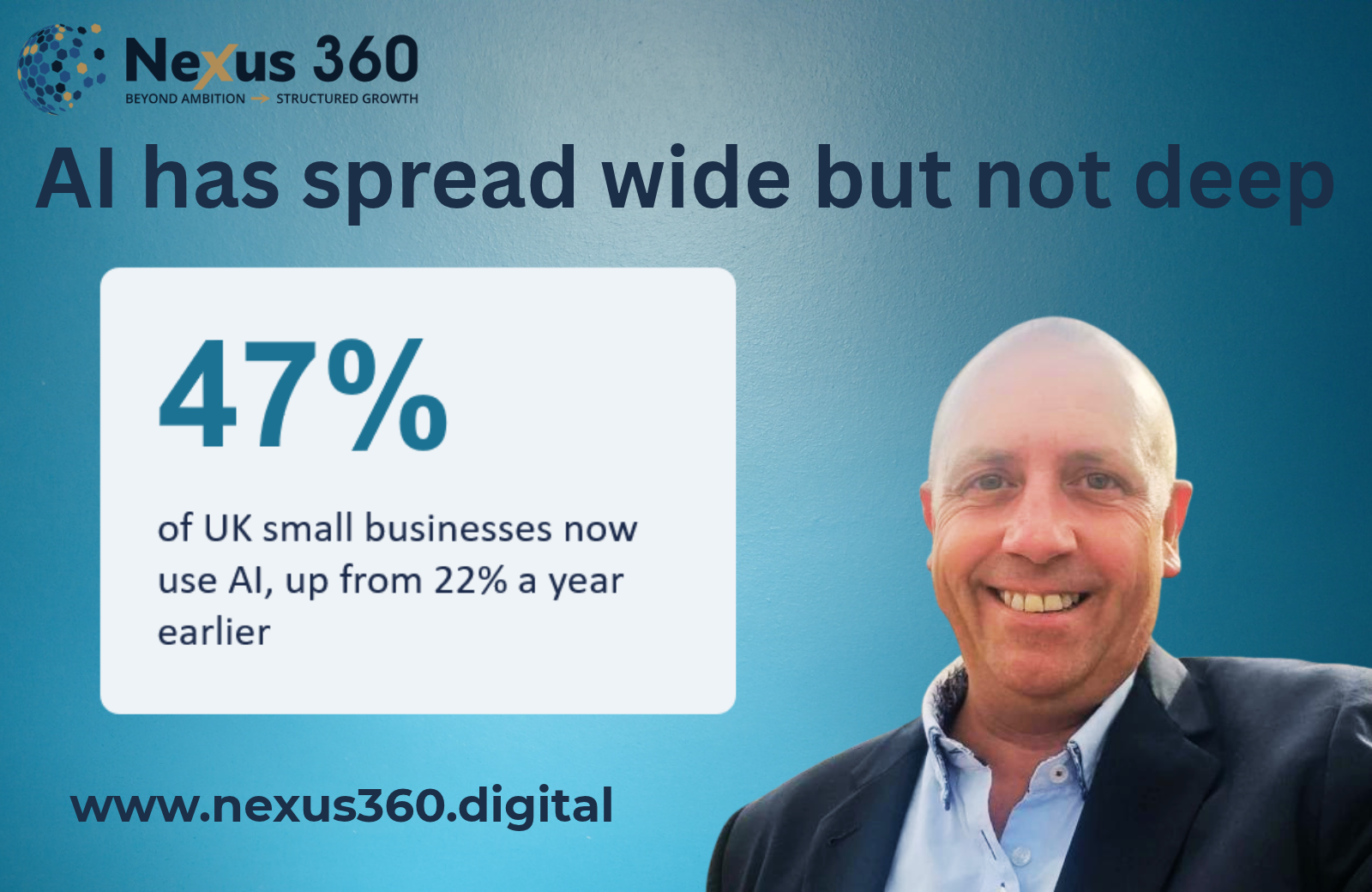
Nexus 360 founder Mark Shevill discussed this on the AI panel at the Festival of Entrepreneurs, NEC Birmingham, in November 2026.
Forty-seven percent of UK small businesses now use AI, up from just 22 percent a year earlier. Yet only 10 percent of adopters use it extensively, and the average business uses fewer than two AI tools. Having access to artificial intelligence is no longer an advantage in itself. The real benefits of AI for small business come from connecting these tools directly to how your company actually runs.
The current state of AI in smaller businesses
Adoption is spreading rapidly across the commercial landscape. According to the U.S. Chamber of Commerce, 58 percent of small businesses have now adopted generative AI, a sharp increase from 40 percent in 2024. The financial impact is already measurable. A 2025 study by Intuit QuickBooks found that 74 percent of small businesses using AI report a direct boost in productivity.
Despite these numbers, a significant knowledge gap remains. Research shows that 67 percent of micro-businesses admit they know little to nothing about the technology. Many owners buy a subscription to a popular tool, test it for a few weeks, and then abandon it because it does not integrate with their daily workflow. They end up with isolated software that requires manual data entry, defeating the purpose of automation.
A beginner’s glossary of AI terms
Before looking at specific applications, it helps to understand the core technologies driving these changes. You do not need a computer science degree to buy the right software, but knowing the basic terminology prevents costly mistakes.
Machine Learning
Machine learning involves systems that spot patterns in large amounts of data. Think of a local flower shop tracking years of sales data alongside weather reports. A machine learning tool can analyse this historical data to predict that specific bouquets sell best on rainy Tuesdays. This insight helps the owner order the exact right amount of stock and reduce waste.
Natural Language Processing (NLP)
Natural Language Processing is the technology that allows computers to read, understand, and generate human text or speech. This is the engine behind modern customer service systems. Instead of just routing a customer inquiry to a general inbox, an NLP system can read the email, categorise the intent and update your CRM before drafting a personalised response for a human to approve.
Generative AI
Generative AI refers to tools like ChatGPT that create entirely new content based on your instructions. These systems can write marketing emails, summarise meeting notes, or draft reports by predicting the most logical sequence of words based on their training data.
Where competitive advantage is actually emerging
The true benefits of AI for small business do not come from writing faster blog posts. Competitive advantage is emerging in operational efficiency and customer experience. The companies pulling ahead are using technology to handle the predictable work so their human staff can focus on complex problem-solving.
One major advantage is the ability to answer every call and enquiry instantly. Customers expect immediate responses, and AI voice assistants or intelligent routing systems ensure that no lead goes cold. Another critical advantage is connecting AI to your CRM, accounts, and booking systems. When these platforms talk to each other, data flows seamlessly from a sales enquiry to a final invoice without anyone needing to copy and paste information.
Smart businesses are also using their own proprietary customer data to train internal AI tools. This creates a system tailored to your specific operations and client history, something rival companies cannot copy. Finally, ensuring your business is recommended by ChatGPT and Google AI search is becoming a distinct advantage as consumers shift how they look for local services.
Real-world examples of AI in action
Abstract concepts are harder to grasp than practical applications. Seeing how other companies apply these tools helps clarify the potential for your own operations.
Consider a busy local restaurant. During the dinner rush, staff often miss phone calls. By implementing an AI voice assistant, the restaurant ensures that if nobody picks up within three rings, the system answers the call. The AI speaks naturally to the customer, checks table availability, takes the booking, processes a deposit payment, and updates the till and EPOS booking system. Staff keep serving tables while every call is answered and the booking is taken.
An HR consultancy faces a different challenge. They must keep client documentation compliant with shifting employment laws. Instead of manually reviewing and rewriting dozens of documents every time government policy changes, the consultancy uses a connected AI system. The software monitors official policy updates, identifies which clauses in the employee handbooks need changing, and automatically drafts the revisions for a senior consultant to review and approve.
Categorising the benefits of AI for small business functions
Different departments require different approaches. Breaking down the technology by business function makes implementation much easier to manage.
Bookkeeping and finance
Financial analysis is one of the fastest-growing use cases for artificial intelligence. A Goldman Sachs report notes that using AI for financial analysis and business planning more than doubled over two years, reaching 42 percent of AI users in 2026. Tools like Intuit QuickBooks use AI to categorise expenses automatically, forecast cash flow based on historical trends, and flag unusual transactions. This helps business owners outgrow spreadsheets and make decisions based on real-time data.
Customer service and sales
Sales teams often spend hours logging calls and writing follow-up emails. This is exactly why CRM systems fail in many businesses. The administrative burden outweighs the perceived benefit. By integrating AI, the system can transcribe sales calls, extract the key action items, and update the client record automatically. Working with a GoHighLevel consultant can help you build these automated sequences so your sales team spends their time talking to prospects rather than doing data entry.
Content creation and marketing
Marketing requires consistent output. Generative AI tools like ChatGPT or Shopify Magic help small teams produce product descriptions, social media updates, and email newsletters at scale. The key is using these tools for the first draft, allowing your human experts to refine the tone and add specific industry insights before publishing.
The cost of standing still versus the risk of rushing in
Doing nothing carries a heavy cost. Businesses actively using AI expect strong productivity gains, while those with no plans expect a decline in relative performance. Customers increasingly expect instant responses, and your staff are likely already using unapproved AI tools on their personal devices to speed up their work.
However, you must balance the cost of standing still with the cost of rushing in. Large-company AI pilots often fail because tools are bolted on without changing how the work is actually done. Buying a new software license does not fix a broken process. You have to redesign the workflow first.
Smaller businesses have a distinct advantage here. They can move faster than corporate giants because they make quicker decisions and have less legacy technology to unpick. An SME can scale without adding headcount by adopting efficient tools rapidly. And despite the persistent myth that AI steals jobs, the data shows the opposite. The BCC finding that 54% of UK SMEs are adopting AI and actually increased their workforce over the past year. Efficiency drives growth, and growth requires people.
Five steps to implement AI in your business
Moving from theory to practice requires a structured approach. We recommend following these five steps to begin integrating artificial intelligence safely and profitably.
1. Check what AI says about your business
Open ChatGPT or Google’s AI search and ask about your company. See what these systems currently tell potential customers. If the information is outdated or incorrect, you need to update your public profiles, directory listings, and website content so the AI engines pull the correct data.
2. Find where you lose money
Identify the manual tasks that consume your team’s time. This might be manual data entry, chasing unpaid invoices, or answering the same basic customer questions every single day. These bottlenecks are your prime targets for automation.
3. Map that process
Write down every step of the task as it happens now. You cannot automate a process you do not understand. Documenting the workflow reveals the unnecessary steps. We use a framework called The Growth Equation to help clients map exactly how value flows through their organisation.
4. Automate it with your systems connected
Link your new tools directly to your existing software. If you use Sage for accounts, ensure your new automation and workflow feeds data straight into it. Isolated tools create more work, while connected systems remove manual data handling entirely and improve profit margins.
5. Set a simple AI policy for staff
Your team is likely already experimenting with these tools. Write a clear, one-page policy explaining which applications are approved, what company data can be shared externally, and how staff should verify AI-generated outputs before sending them to clients.
Maximising the benefits of AI for small business growth
Technology should serve your commercial goals, not dictate them. The true benefits of AI for small business materialise when you stop looking for magic software and start looking for operational friction. By understanding your current bottlenecks, designing a connected system, and building the solution carefully, you can eliminate manual admin and build a company that scales profitably.