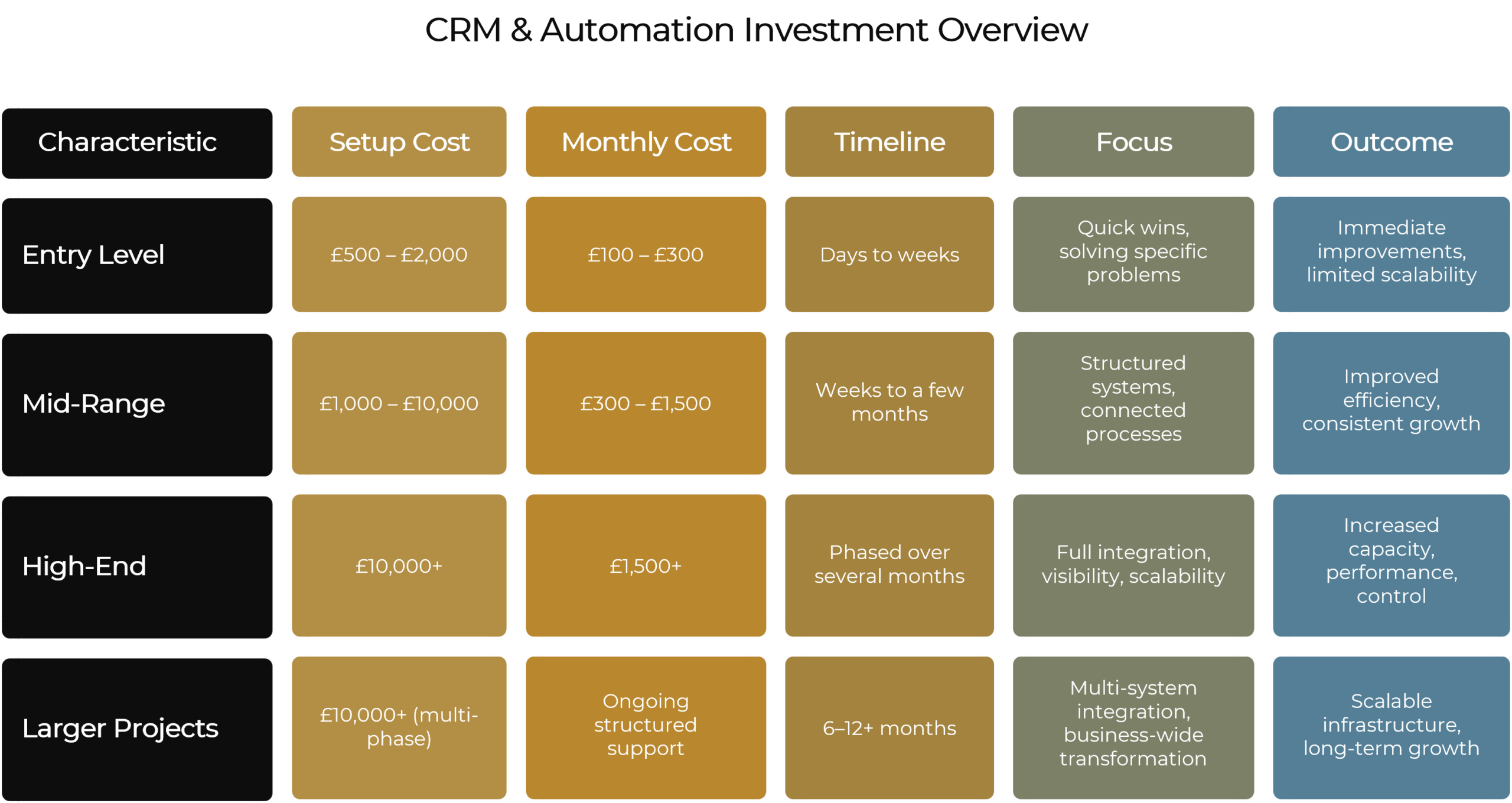
- The initial CRM and automation cost for a basic setup ranges from a few hundred to a couple of thousand pounds upfront, with ongoing UK costs from £100 – £300 per month.
- More structured systems built for growth usually require an upfront investment between £1,000 to £10,000+, alongside £300 – £1,500+ monthly for platform access and operational support.
- Implementation timelines vary from a few weeks to several months, and it is usually much safer to treat the rollout as a phased roadmap rather than changing everything at once.
Let’s just address the question that comes up at some point in every conversation
“How much does CRM and automation cost for a business like mine?”
Because whether it’s early on or further down the line, every business ends up asking it in one way or another. Not always directly, but it’s there in the background… are we talking hundreds, thousands, or something much bigger?
It’s a fair question, and one that should be answered properly.
What tends to happen though is that the answers you find are either vague, or they sound simple on the surface but don’t really reflect what’s involved once you get into it. Suppliers avoid the pricing; they don’t want to risk putting you off before the conversation has even started. The question is, what’s better, having a rough idea upfront, or getting halfway through a conversation only to realise it’s completely outside your price bracket?
So rather than going around it, it makes more sense to break it down properly and explain how this works in practice.
Nexus 360 is a UK-based business growth consultancy with over 20 years of combined experience across CRM, automation, and operational change. The business was Highly Commended for Most Promising New Business at the Barnsley & Rotherham Chamber of Commerce Business Awards 2025.
Understanding the Two Types of CRM and Automation Cost
Before getting into numbers, it helps to look at how this is usually structured.
Most businesses already think in these terms, even if they don’t label it this way. There’s the upfront investment to get things set up, and then there’s the ongoing cost to keep everything running.
The upfront side is the capital cost. That’s the work involved in putting the right structure in place: setting systems up, connecting things properly, and making sure it reflects how your business operates.
Then there’s the operational side, which is the ongoing cost of running it. That covers the platform itself, the automation, and the continued support needed to keep things working as the business evolves.
Where this starts to cause confusion is when those two are looked at separately. According to the UK Department for Business and Trade’s review of technology adoption among UK SMEs, integration, training, and ongoing management tend to be the costs that businesses miss most when first evaluating digital tools.
A low monthly cost might look appealing, but if there’s very little behind it in terms of setup, it often creates more work than it saves. On the other hand, a large upfront investment without any ongoing structure can drift over time and lose its value.
It’s the balance between the two that determines whether this works, not just in the short term, but as the business grows.
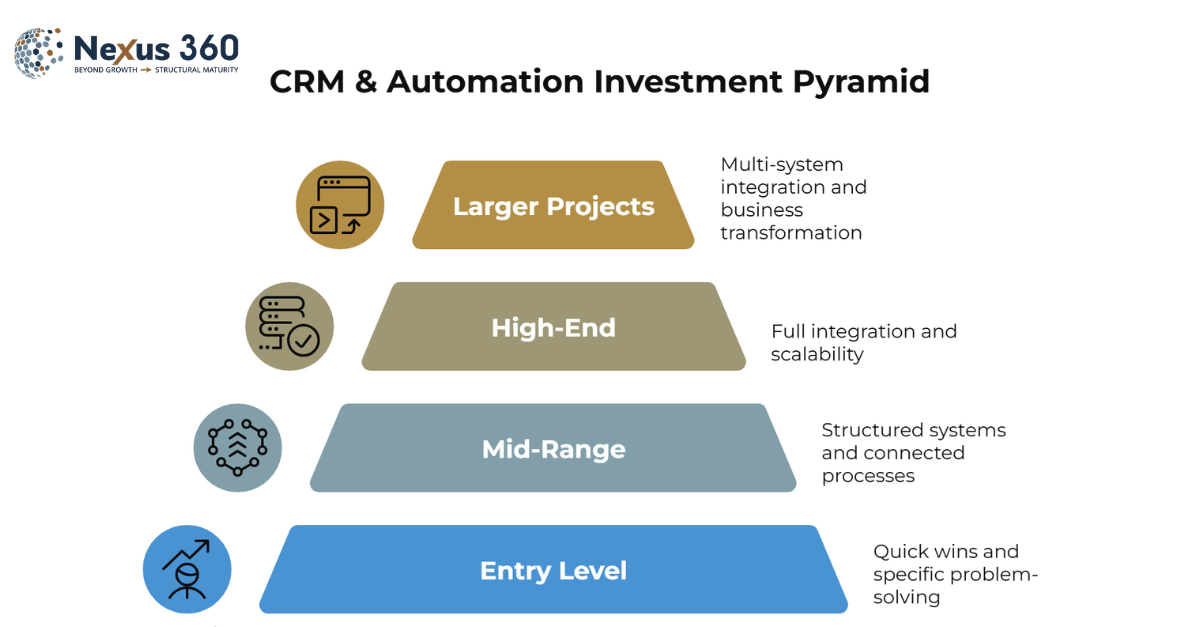
Entry Level CRM and Automation Costs
This is where most businesses naturally start, especially if there’s an immediate problem they’re trying to solve, or a level of nervousness around trying something new or changing how things are currently done.
At this level, the focus is usually on getting something in place quickly, testing the waters so to speak. That might be improving how enquiries are captured, putting some basic follow-up in place, or introducing a CRM so everything isn’t sitting across emails, spreadsheets, and different systems.
The investment here is typically lower, both in terms of upfront cost and ongoing spend, and it can deliver value relatively quickly.
That said, there is usually a trade-off.
What tends to happen at this level is that things are set up around the immediate need rather than the bigger picture. Systems might not be fully connected, processes can still vary slightly depending on who is doing the work, and there’s often a level of manual handling sitting behind it.
It works, and for many businesses it’s the right place to begin, but it doesn’t always scale cleanly as things grow.
Mid-Range CRM and Automation – Where Things Start to Work
This is where most established businesses tend to sit, especially once things are moving consistently and there’s a steady flow of enquiries, customers, and ongoing work.
At this stage, the conversation usually shifts slightly. It’s less about getting something in place quickly, and more about making what’s already there work properly. Understanding your specific CRM and automation cost requirements becomes more important as you seek a higher return on investment.
That might mean connecting systems that currently sit in isolation, introducing more structure into how work moves through the business, or reducing the reliance on individuals to keep things running day to day.
The investment here is more balanced. There’s still an upfront element to get things set up correctly, but there’s also a focus on ongoing structure so that what’s put in place continues to work as the business grows.
What happens at this level is that businesses start to feel the benefit quite quickly. Enquiries are handled more consistently, follow-up improves, and there’s less pressure on the team to remember what needs to happen next.
As a reference point, one UK business was spending between three and five full days every month manually producing reports for its distributor network. Once automation was in place at this level, that workload dropped to almost nothing – saving around 60 hours a month across the team.
It’s not about adding more tools or making things more complicated but about bringing everything together so the business runs in a more controlled and predictable way.
For many businesses, this is where the return on investment becomes clear, not just in terms of time saved, but in how much more of the work already coming in actually turns into revenue.
High-End – Built for Scale and Control
This is the stage many businesses are working towards, even if they’re not quite there yet.
By this point, the focus moves beyond fixing individual parts of the business and into how everything works together as a whole. Systems are no longer sitting alongside each other, they’re properly integrated, with information flowing between them in a way that supports how the business operates day to day. That might include CRM, finance systems, operational workflows, and reporting, all connected so there’s a clear view of what’s happening across the business at any given time.
The investment here is naturally higher, both in terms of setup and ongoing structure, but it’s aligned to a different level of outcome. This isn’t necessarily about saving a bit of time or making small improvements. It’s more about being able to handle more volume, improve conversion rates, and grow without constantly needing to add more people to keep up.
What happens at this level is that the business gains a much stronger sense of control. Decisions are based on accurate, real-time information, processes are consistent, and there’s far less reliance on individuals to keep things moving. For businesses operating at this level, the total CRM and automation cost is viewed through the lens of capacity, performance, and long-term growth.
To give a sense of what this looks like in practice, one UK SME that implemented full CRM integration and workflow automation reported over £4.2 million in confirmed business growth as a direct result of the changes made.
This Isn’t a Big Bang Approach – It’s a Controlled Roadmap
One thing that’s worth understanding at this point is that this doesn’t and shouldn’t need to happen all in one go. Especially on the larger projects.
In most cases, trying to change everything at once is where it starts to become difficult. The business is already running, customers still need to be looked after, and introducing too much change too quickly can create more disruption than improvement. It’s also important to recognise that generally people are adverse to change, so a gradual introduction of change is more beneficial.
A more effective way to approach it is to treat this as a roadmap, where the right pieces are put in place at the right time.
That might start with something relatively simple, like improving how enquiries are captured or putting more consistent follow-up in place. From there, the next step is usually about bringing things together properly, connecting systems, reducing manual handling, and introducing more visibility across what’s happening day to day.
Over time, that builds into something much more structured, where everything works together in a way that supports the business rather than slowing it down.
The important part is that nothing is forced. The business continues to operate, deliver, and grow, while the structure underneath it is steadily improved.
As that happens, it naturally becomes less about a one-off piece of work and more about having the right level of ongoing support in place, so that what’s been built continues to adapt as the business moves forward.
What Is the Expected CRM and Automation Cost for Setup?
By this point, it should be clear that there isn’t a single number that fits every business.
The investment depends on where you’re starting from, what’s already in place, and how far you want to take it. That said, having some realistic ranges helps to put things into context and give you a feel for what this might look like in practice.
Entry Level – Lower Investment, Quick Wins
At an entry level, where the focus is on getting something in place quickly and solving a specific problem, you’re typically looking at a lower upfront investment.
That’s often in the region of a few hundred to a couple of thousand pounds, with ongoing costs starting from around £100-£300 per month depending on what’s included.
In terms of timescales, this is usually something that can be put in place relatively quickly, often within a few days to a few weeks depending on what’s involved.
This is about improving specific areas rather than transforming the whole business.
Mid-Range – Structured and Built to Grow
As you move into a more structured approach, where systems are connected properly and processes are built to support the business as it grows, the investment naturally increases.
Setup is typically in the range of £1,000 to £10,000, depending on complexity, with ongoing support and platform costs usually sitting between £300-£1,500 per month.
This level of work usually takes a little longer, often spanning a few weeks to a couple of months, as the focus is on getting things properly structured rather than just putting something in place.
This is where most established businesses sit, and where the return on investment becomes much more visible.
High-End – Integrated and Scalable
At the higher end, where the focus is on full integration, visibility, and building something that can support scale, the investment becomes more significant.
Setup generally starts from £10,000+, with ongoing investment moving into £1,500+ per month, reflecting the level of structure, support, and continuous improvement involved.
At this level, the work is typically delivered in phases, often over a period of a few months, allowing changes to be introduced in a controlled way without disrupting the business.
The conversation here is less about cost and more about capacity, performance, and long-term growth.
Larger Projects – When the Scope Expands
In some cases, particularly in larger or more complex businesses, the scope can extend beyond this.
That might involve multiple systems across different departments, deeper integrations across finance and operations, or phased rollouts across teams or locations.
In these situations, both the investment and the timeline naturally increase.
It’s not uncommon for this type of work to run over 6-12 months or more, it may involve bringing in additional resources and skills to build out a project team depending on the scale of the business and the level of integration involved.
That said, this is rarely delivered as a single large piece of work. It’s broken down into stages, allowing improvements to be introduced steadily while the business continues to operate as usual.
Bringing It Back to Reality
What matters more than the exact numbers is how that investment is introduced into the business, and what it’s there to support over time.
At its core, this is about putting the right structure underneath a business that’s already moving, already generating work, and already delivering for its customers.
As businesses grow, certain areas naturally start to feel stretched. Enquiries take a little longer to respond to, follow-up becomes less consistent, systems don’t quite line up, and more of the day-to-day relies on people keeping things together.
An initial improvement brings a bit more control, enabling processes to run more smoothly, and the next step becomes easier. From there, it builds steadily, each stage adding to what’s already in place and strengthening how the business operates. Industry research from Gartner consistently shows that structured systems and automation play a key role in improving operational efficiency.
It’s a view echoed by people who’ve seen this work at first hand. As one implementation lead put it after completing a similar project: ‘Investing in the right CRM and integrations is not about technology for its own sake. It’s about giving your people the tools they need to deliver great service, at scale, every day.’
That’s the roadmap approach.
A series of considered improvements, introduced at the right time, allowing the business to continue running, delivering, and growing while the structure underneath it is gradually strengthened.
With that approach, day-to-day operations are protected, the team has time to adapt to the changes being introduced, and the investment is spread in a way that feels manageable. Each stage delivers its own return, so the improvements start to pay for themselves as they are put in place.
Over time, that’s what delivers the real return. Not a single change, but the cumulative effect of getting the right foundations in place and building on them as the business moves forward.
How much does CRM and automation cost in the UK?
The cost varies depending on the level of structure you need. At a basic level, you might be looking at a few hundred pounds to get started, whereas more structured or integrated solutions can run into several thousand for setup, with ongoing monthly costs depending on the level of support involved.
How long does it take to implement CRM and automation?
That depends on the complexity. Some improvements can be put in place within days or weeks, while more structured implementations can take a few months. Larger, phased projects can run over 6-12 months as systems are introduced in stages.
Do I need to do everything at once?
No, and in most cases, it’s better not to. A phased approach allows improvements to be introduced gradually, Pillaging and making it easier for teams to adapt.
Is CRM and automation worth it for a growing business?
If your business is generating regular enquiries and starting to feel harder to manage, putting the right structure in place can make a significant difference. It improves consistency, reduces pressure on the team, and helps more of the work already coming in turn into revenue.