Are you much the same as other growing businesses that have accumulated systems over time?
The accounting software managing the finances. A CRM platform that tracks customers and opportunities. Project management tools organising delivery and of course, lots of spreadsheets thrown into the mix which appear to bridge the gaps.
A new tool solves an immediate problem, often it feels exciting and helps the team move forward.
Over time, the number of systems you have begins to increase with information starting to live in multiple places. Teams find themselves moving data between platforms manually. Simple questions about customers, projects or revenue require checking in several systems before you can get the full picture.

This is where the hidden cost of disconnected business systems begins to appear. The issue, often, lies in the way those systems operate alongside each other without a clear operational structure connecting them rather than a single tool.
When Business Systems Stop Working Together
With a spreadsheet filling the gap between systems, it’s simple as everyone know how to keep things in a quick spreadsheet. At first, it doesn’t feel like a problem. Someone on the team exports a report from one platform and uploads it into another. A few manual steps keep everything running smoothly and the business carries on moving.
As the business grows though, the volume of information increases. More customers, more projects, more activity across the systems the business relies on every day and so the connections between your systems start to matter far more than the tools themselves.
You may notice that the team are spending more time checking information across platforms. One system says one thing, another system says something slightly different. Information takes longer to gather because of the data needing to be pulled together from several places before it can be trusted.
At that point, the systems in the business are no longer supporting each other.
They are simply existing alongside one another.
The Operational Cost No One Sees
As none of this shows up as a single obvious problem, the business continues to function perfectly fine. Customers are still being served, projects are still delivered as efficiently as ever. Everything appears to be working, but inside the organisation, small inefficiencies begin to accumulate.
People spend time checking information across systems to confirm which version is correct. Data gets entered more than once because the platforms being used do not share information easily. Reports take longer to prepare because the full picture sits across several different tools. Individually these moments feel small.
However, when you begin to look at the bigger picture and add all these small moments together, they begin to consume a surprising amount of time.
You might notice the team spending more effort maintaining the systems than benefiting from them. Simple questions about customers, projects or revenue start requiring several checks before a confident answer can be given.
That is usually the point where the operational cost of disconnected business systems becomes visible. The reason being is that the structure connecting the applications together has never been deliberately designed.
Research regularly highlights the impact of fragmented systems inside organisations. In fact, a Harvard Business Review article on breaking down data silos explains that one of the biggest barriers to using business data effectively is simply gaining access to information spread across different systems.
The Problem Is Structural, Not Technological
When this becomes more obvious with a business, the first instinct is to often look for a better solution in terms of a new application or use a new more advanced technology solution
A new platform promises improved benefits. Another tool claims to automate a process that currently takes too long. Something else offers to bring everything together in one place.
Adding another system can feel like progress but the business often already has the tools it needs. Accounting software manages the finances. A CRM platform tracks customers and opportunities. Project management systems organise delivery.
Each system performs its role well. Every new tool solved a problem when it was introduced. Few were selected with the intention of forming part of a connected operational framework.
Over time the business ends up with capable systems operating in isolation from one another. At that point the challenge structural rather than technological.
What Structured Businesses Do Differently
As businesses grow, the systems running the organisation become more important.
More customers, more projects and more activity increase the amount of information moving through the business every day. Accounting systems, CRM platforms and operational tools all begin to play a bigger role in keeping everything running smoothly.
At some point a realisation tends to occur that growth has introduced more tools into the business. Each one serves a purpose and each one helps solve a particular operational need. This is when it is important to ask
“How do those systems work together?”
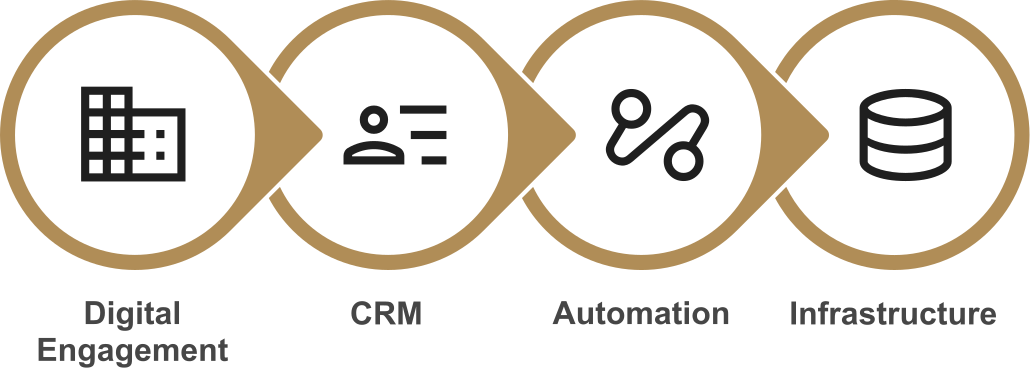
Businesses that scale successfully start looking at their systems as part of a connected operational framework rather than individual tools solving isolated problems. Accounting systems, CRM platforms, project management tools and digital engagement platforms all serve different purposes.
When those systems are structured to work together, information flows more easily across the organisation with teams gaining a clearer view of customers, opportunities and delivery.
Growth inevitably introduces complexity into any organisation. Operational structure simply ensures that complexity remains manageable.
Many growing businesses reach a stage where their systems reflect years of practical decisions rather than a deliberate operational design. Recognising that moment is often the first step toward building the structure that allows the business to scale with greater clarity and control.
If you stopped for a moment and looked at the systems supporting your business today, would they feel like a connected framework or a collection of tools that evolved over time?