Research shows that 30 percent of average daily workloads can be automated. Small and medium enterprises lose hundreds of hours each month to administrative bottlenecks. Manual data entry and fragmented IT systems drain resources. The automation of processes solves this problem directly. It connects disparate business functions so work moves forward without constant human intervention. At Nexus 360, we apply decades of enterprise-level delivery experience to help smaller businesses scale.
Our founder Mark Shevill managed complex technology projects for major organisations like RBS and Thomas Cook. He built Nexus 360 on the principle that sustainable growth requires solid operational foundations. This guide explains how modern automation technologies work. You will learn the exact steps required to implement them and the tangible returns you can expect when you stop relying on founder dependency.
Understanding the terminology: BPA, RPA, and BPM
Software acronyms often confuse IT infrastructure planning. Enterprise leaders like IBM clarify that these technologies solve entirely different problems. Knowing these distinctions helps you choose the right software for your specific bottlenecks. Industry reports, such as the Gartner Magic Quadrant for BOAT (Business Orchestration and Automation Technologies), evaluate these platforms based on their ability to handle complex, multi-step operations.
Robotic Process Automation
(RPA)
As IBM notes, RPA handles routine, rules-based tasks that mimic human interaction. If a staff member copies data from a spreadsheet and pastes it into a billing system, an RPA bot executes the exact same sequence faster and without typographical errors. RPA works well for legacy systems that lack modern integration capabilities.
Business Process Automation
(BPA)
This approach connects multiple IT systems to handle complex workflows. Instead of just mimicking a human click, BPA integrates databases and applications via APIs. Information flows naturally across the organisation. When you look at Business Automation Insights, you will see that BPA focuses on the entire data journey rather than isolated tasks.
Intelligent Document Processing (IDP)
Often used alongside RPA, this technology extracts data from unstructured documents like PDF invoices or scanned receipts. It converts image text into structured data that your ERP system can read and process automatically.
Business Process Management
(BPM)
IBM defines BPM as the broader discipline of modelling, analysing, and optimising how your company operates. BPM is the overarching strategy. RPA and BPA are the specific tools used to execute that strategy.
How process automation works in practice
Integration providers like TIBCO often use a car wash analogy to explain complex IT systems. When you drive up to the payment terminal, you do not need to speak to an operator. You insert your card. The system registers the payment immediately. This action triggers a sensor that tells the entry gate to open. As you drive forward, optical sensors measure the length of your vehicle and instruct the water jets, soap dispensers, and brushes to activate in a precise sequence. The entire operation runs without a single human employee managing the equipment.
Business automation works exactly the same way. A client submits a form on your website, which acts as the payment terminal. This action triggers your CRM to create a new contact record. The system then alerts your sales team, schedules a follow-up task, and sends a welcome email to the prospect. The information updates across the organisation without manual effort. The result is an operation that runs efficiently, reducing lead response times from hours to seconds.
Core IT and business processes you can automate today
The highest returns come from targeting repetitive, data-heavy tasks that slow down your team and introduce human error. Work management platforms like Monday.com specifically highlight data entry, record updates, and multi-step approval workflows as prime candidates for automation.
Data entry and record updates
Moving information between a marketing platform and an ERP system like Sage is a prime candidate for automation. When systems communicate directly, you eliminate duplicate data entry. For example, Nexus 360 automates everyday processes like lead follow-ups, appointment scheduling, and client management. This ensures your sales team always has accurate, up-to-date information without typing notes manually.
Multi-step approval workflows
Monday.com and similar platforms frequently highlight approval chains as a major efficiency drain. You can build systems that automatically route purchase orders to the correct manager based on the invoice amount. If the request sits unapproved for 48 hours, the system sends an automatic reminder. This keeps projects moving and prevents documents from getting lost in crowded email inboxes.
Specific department functions
Human resources onboarding requires dozens of small steps, from provisioning IT accounts to sending tax forms. Procurement teams often use Microsoft Power Automate or SAP procurement solution templates to standardise purchasing across multiple sites. Automating these sequences ensures compliance and speeds up delivery. By targeting these specific areas, you build a foundation for scalable growth.
The implementation framework: Design, Automate, Optimise
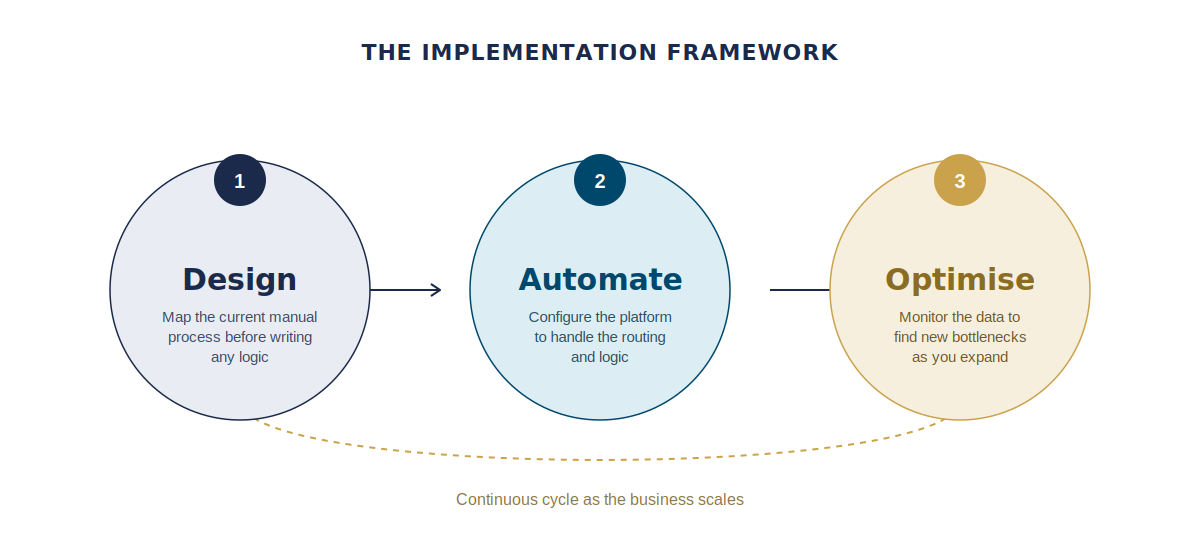
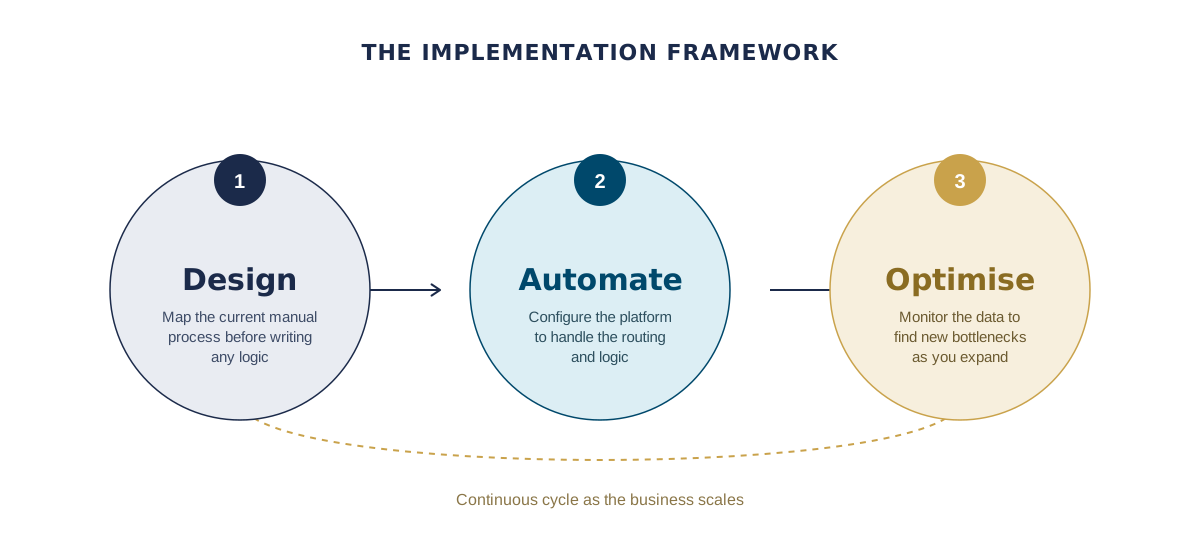
Successful IT projects start with a clear methodology, not a software purchase. Enterprise platforms like Appian suggest a continuous improvement strategy based on three distinct phases: Design, Automate, and Optimise. At Nexus 360, we apply a similar model through our The Growth Equation methodology, which follows a strict sequence of Understand, Design, and Build.
First, you must design the workflow. This involves mapping out every step of the current manual process. You cannot automate a broken system. This phase requires you to simplify and standardise the steps. We spend significant time analysing your operational infrastructure to ensure the foundation is solid before writing any logic.
Next, you automate the sequence using a unified platform. For many UK businesses, this means configuring tools to handle the routing and logic. As a GoHighLevel Consultant for UK businesses, we build bespoke solutions that fit your exact requirements. Professional business automation consultants design comprehensive systems that run reliably, rather than just connecting two apps with a basic API trigger.
Finally, you optimise the system. Once the automation is live, you monitor the data to find new bottlenecks. This continuous cycle ensures the technology adapts as your company expands.
Measuring the return on investment and time saved
Concrete data on automation costs and returns is often difficult to find. While large enterprise solutions require massive budgets, SME solutions are highly accessible and deliver measurable results quickly.
The primary return on investment comes from time saved. If a team of five spends ten hours a week on manual admin, that equals fifty hours of lost productivity. At an average hourly rate of twenty pounds, the business loses one thousand pounds a week to inefficiency. By implementing automation and workflow systems, you reclaim those hours. We have seen the impact of this at scale. In a recent infrastructure project across 35 production sites and 49,000 managed devices, streamlined processes saved thousands of labour hours.
Implementation timelines vary based on your requirements. A basic CRM setup might take three to four weeks. A complex ERP integration across multiple sites could take three to six months. The cost of CRM and automation depends on the complexity of your legacy systems and the volume of data you need to migrate. The investment typically pays for itself within the first year through reduced labour costs and increased sales capacity.
Moving beyond basic software connections
Basic API triggers have their place, but true operational structural maturity requires a deeper level of integration. When you rely on dozens of disconnected apps, your data becomes fragmented and difficult to analyse.
A professional approach involves centralising your operations. This might mean using a comprehensive platform to manage your digital engagement, CRM and client journey, and workflow orchestration in one place. For example, you can automate the entire posting process across platforms like Instagram, Facebook, and LinkedIn. A mature system ties that social engagement directly back to your sales pipeline, tracking which posts generate revenue.
We have supported over 40 SMEs across 10 sectors, including automotive, finance, education, hospitality, and professional services. Working closely with businesses in Sheffield and beyond, we ensure that technology investments align with measurable commercial outcomes. You can read more about our approach to see how we sit alongside your team to implement change at a pace your organisation can absorb.
Frequently asked questions
How long does it take an average business to implement process automation?
For a small to medium enterprise, a standard CRM and workflow automation project takes between four and eight weeks from the initial design phase to final testing. Complex integrations involving legacy ERP systems like Sage may take several months to map, build, and deploy safely.
What is the difference between RPA and BPA?
RPA uses software bots to perform repetitive, rules-based tasks exactly as a human would, such as copying data between spreadsheets. BPA connects different IT systems at the database level to manage complex, multi-step business workflows automatically without needing to mimic human clicks.
Is automation only for large enterprises?
No. While large corporations use expensive legacy platforms, modern tools make enterprise-grade automation accessible to SMEs. The focus is on removing manual bottlenecks so small teams can handle higher volumes of work without hiring additional administrative staff.
How much does it cost to automate business processes?
Costs vary widely based on scope. A simple workflow setup might cost a few thousand pounds, while a comprehensive operational infrastructure overhaul requires a larger investment. The exact price depends on the number of systems integrated and the complexity of the data migration.
To begin the automation of processes in your own business, audit your team’s most repetitive daily tasks and calculate the exact number of hours lost to manual data entry each week.