Many founders reach a point where working harder no longer grows the company. You hit a bottleneck. Disconnected systems and manual tasks consume your entire week. If you are looking for a small business consultant UK, you need more than generic advice. You need a structured roadmap to manage growth. At Nexus 360, we help ambitious SMEs build the operational foundations required to scale without burning out the leadership team.

Why small businesses hit a growth ceiling
Founders often fall into a minimum wage mindset. You start by doing everything yourself to save money. Over time, you end up spending hours on administrative tasks instead of focusing on high-value strategy. This psychological barrier leads directly to burnout. You cannot scale a company when the founder is the primary bottleneck for every decision.
The problem usually stems from a lack of structural maturity. You might have one software for sales, another for accounting, and a dozen spreadsheets holding everything together. We see this constantly. Growing businesses outgrow spreadsheets very quickly. When your systems do not talk to each other, your team wastes time on double data entry. This creates a hidden cost of disconnected business systems that eats into your profit margins and slows down delivery.
Eventually, the leadership team looks at the chaos and asks, we’ve got all these issues, what do we actually need? The answer is rarely more software. The answer is a unified approach to how your business operates.
What a small business consultant actually does
The consulting industry is full of vague promises. To get real results, you need specific boundaries. Effective consultants set clear boundaries, often excluding basic IT support and accounting to focus entirely on commercial and operational growth. At Nexus 360, we concentrate on your digital foundations. We deliver specialized systems that actually improve your daily operations.
A good consultant diagnoses your current state, designs a custom roadmap, and builds the solution at a pace your business can absorb. We do not just hand you a strategy document and walk away. We implement the systems. How Nexus 360 works is built entirely around your specific business needs. We look at your current workflows, identify the friction points, and deploy technology to solve them.
Our methodology: The Growth Architecture approach
We use a framework called Growth Architecture to connect the different parts of your business. This approach breaks your operations down into five key areas. By aligning these pillars, we create a predictable environment for expansion.
Operational infrastructure
Your business needs a solid foundation to support new clients and staff. Operational infrastructure covers the core tools and processes your team uses every day. We map out exactly how work flows through your company. This step ensures that everyone knows their responsibilities and has the right tools to execute them. Without this foundation, adding more sales only creates more chaos.
ERP and business systems
Enterprise Resource Planning is not just for massive corporations. Small businesses need centralized systems to manage inventory, projects, and finances. We help you select and implement business systems that fit your current size while allowing room for future expansion. The goal is to give you a single source of truth for your company data.
CRM and client journey
Managing relationships is critical for retention and revenue. We design CRM and client journey systems that track every interaction a prospect has with your brand. From the first inquiry to the final delivery, your team needs visibility into the client journey. A properly configured CRM stops leads from falling through the cracks and helps your sales team close deals faster.
Automation and workflow
Manual repetition kills productivity. We look for tasks that happen the same way every time and automate them. Automation and workflow design can handle invoice generation, follow-up emails, and data transfers between departments. This reduces human error and frees your staff to focus on complex problem solving.
Digital engagement
Your internal systems must connect seamlessly with your external presence. Digital engagement ensures that your website, client portals, and marketing tools feed directly into your operational software. When a customer fills out a form online, that data should instantly populate your CRM and trigger the appropriate internal workflows.
How much does a small business consultant cost?
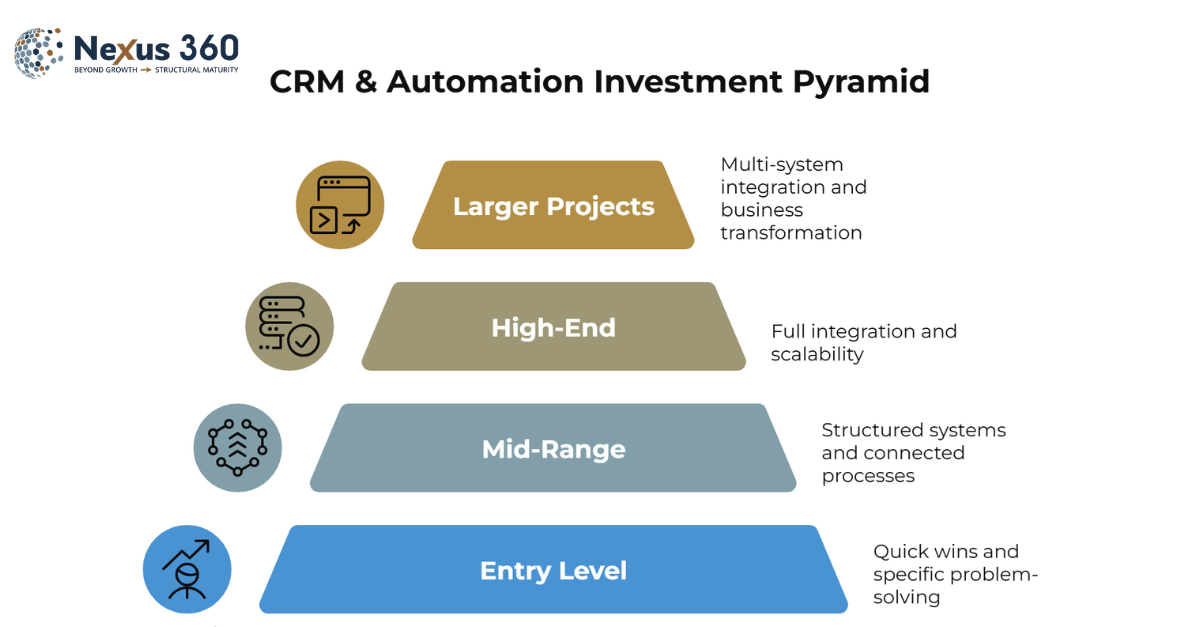
Pricing transparency is rare in the consulting world. Many agencies hide their fees until the end of a long sales pitch. While some basic advisory services in the market average around 250 pounds per month, comprehensive system architecture requires a different model. The exact investment depends entirely on the complexity of your current setup and the goals you want to achieve.
We believe in clear expectations. If you are wondering how much CRM and automation cost for a business like yours, the answer starts with an audit of your existing tools. We scope the project based on the specific modules you need. You only pay for the implementation and training required to get your systems running smoothly. This structured approach ensures you see a direct return on investment through saved time and increased capacity.
Real results from structured business systems
Experience matters when you are restructuring a company. The right operational changes produce measurable growth. Across the industry, top consultants deliver concrete outcomes. For example, effective system implementation has helped childcare businesses scale from a kitchen table idea to a 3 million pound turnover operation with over 100 staff. We bring this level of discipline to small business challenges. We understand how to scale operations because we focus on the mechanics of growth. Your new systems are built to last.
Integrating modern tools and AI for SMEs
The technology landscape changes rapidly. Many small businesses hear about artificial intelligence but have no idea how to apply it to their daily operations. We cut through the noise. We integrate smart tools that actually make a difference in your workflow.
Whether it is using AI to summarize client meetings in your CRM or deploying smart assistants like Clvrly to handle initial website inquiries, we focus on practical applications. We do not implement technology just for the sake of it. Every new tool must solve a specific problem or create a measurable efficiency gain. This modern approach keeps your business competitive in a crowded market.
Frequently asked questions about business systems
Business owners often have the same concerns when they start looking for operational help. We have compiled the most common questions we hear during our initial consultations. You can read more detailed answers in our insights articles.
Do small businesses really need a CRM?
Yes. Relying on memory, sticky notes, or basic spreadsheets limits your growth. A CRM centralizes your contact data, tracks communication history, and provides a clear view of your sales pipeline. If you want to know if small businesses need a CRM, look at how much time your team spends searching for email threads or trying to remember when to follow up with a prospect.
Will automation increase the value of my business?
Buyers look for companies that run smoothly without the constant involvement of the founder. Documented, automated processes make your company highly attractive to investors. If you plan to sell or step back eventually, you must prove that the business can operate independently. You can read more about how automation will increase the value of your business by removing single points of failure.
Where do we start when systems are hard to manage?
The first step is always an honest assessment of your current state. You cannot fix a tangled web of software by simply buying another subscription. We recommend mapping out your ideal client journey first. Once you know where to start when business systems are harder to manage, you can identify which current systems are helping and which are causing friction.
Why do CRM systems fail in many businesses?
Implementation fails when companies buy software without a clear strategy. They expect the tool to magically fix their broken processes. Why CRM systems fail in many businesses comes down to a lack of preparation. Successful adoption requires proper training, clear data entry rules, and a system designed around the way your team actually works.
Take the next step with a small business consultant UK
Fixing your operational infrastructure is the most effective way to improve margins and reduce your daily workload. You do not have to figure out the technical details alone. By partnering with a specialized small business consultant UK, you get a clear roadmap and hands-on implementation. We take the time to understand your specific challenges and build solutions that allow you to scale with confidence. Contact Nexus 360 today to discuss your current systems and map out your path to structured growth.